
Global Datasets
Learn how to create and manage Global Datasets

Global Datasets allow you to define and manage datasets centrally for use across multiple projects. Created at the server level, these datasets can be added to any project that requires them. Updates to details, settings, or metadata fields are automatically applied to all projects using the dataset. This eliminates the need to make changes on an individual project level, reducing administrative effort and ensuring consistency and standardisation.
If you have the Dataset Administrator role, you can create Global datasets via the Administration Page or by creating a new dataset and converting it into a Global dataset (see Creating New Dataset page).
Administration Page
- Open the Administration Page from the hamburger menu
- Select Global Datasets
- Click the '+New Global Dataset' button
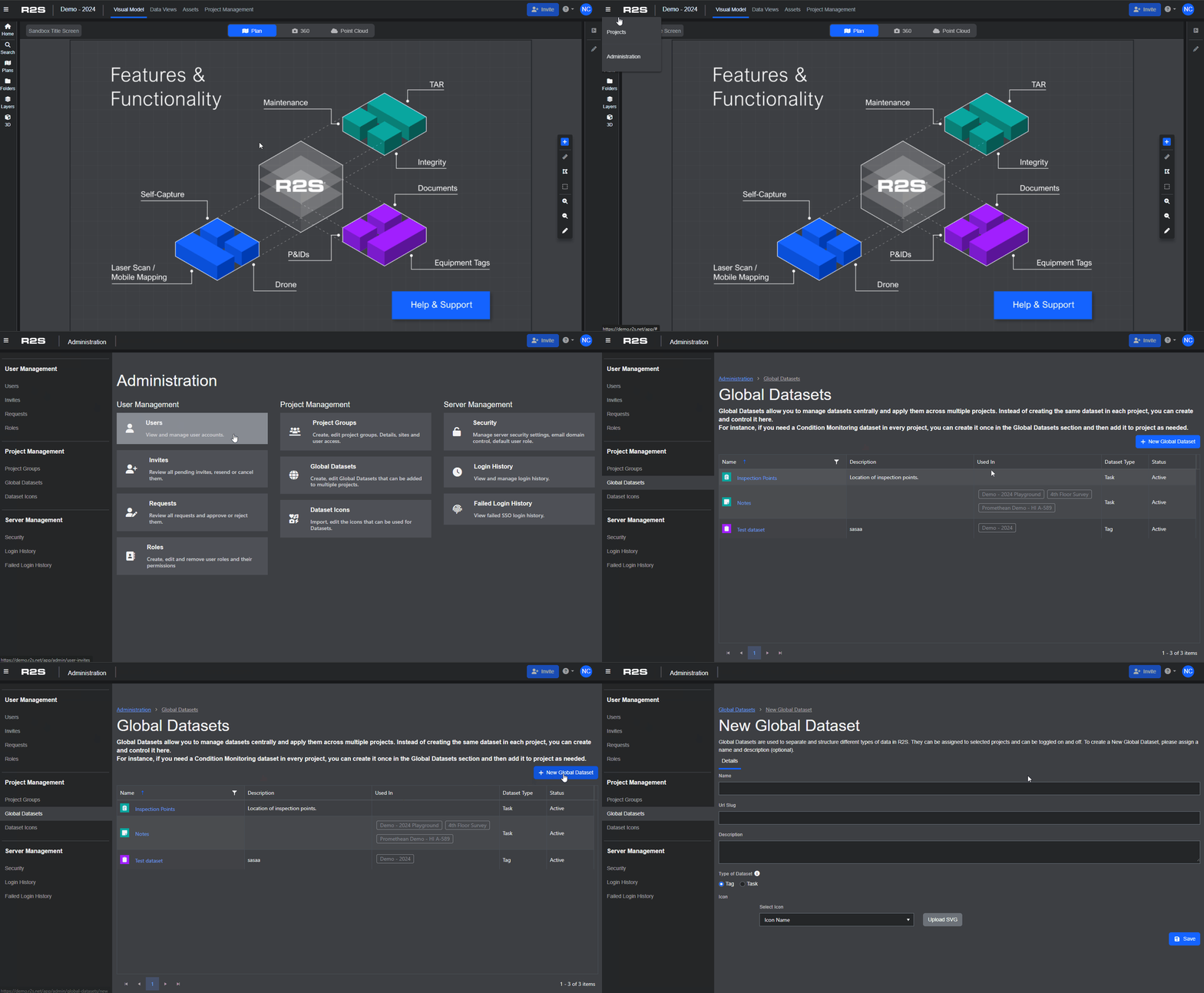
Details tab
- Choose a name for the Dataset.
- Add a description summarising the dataset’s content and purpose (optional).
- Choose the type of data the Dataset represents. Use 'Tag' for physical items or 'Task' for work related items (this also changes the colour of the tag).
- Select the icon you want to use from the dropdown list or upload your own icon in .SVG format.
- Click 'Save' to create the Dataset.
.png)
Projects tab
- Click '+Add Projects' button to access a drop down list of all projects available on the server.
- Select one or more projects from the list.
- Click 'Add'.
.png)
All the projects that are using the Global Dataset are now listed, you can remove or add new projects as required.
For all the projects listed, the dataset will be available and you could go ahead and start adding tags or tasks, however, for a more complete setup, the Settings and Metadata tabs should be configured.
Settings Tab
Control how the dataset is viewed and what users can do with it.
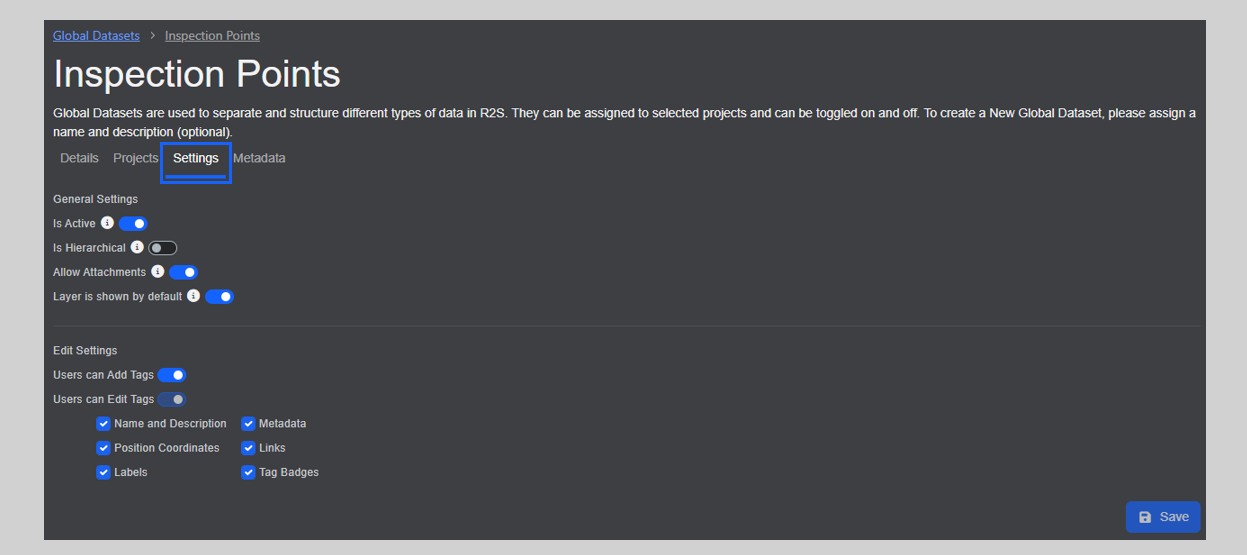
General Settings
- Is Active - when enabled, the dataset and all it's tags will be available in the project to all users.
- Is Hierarchical - enables the ability to view parent and child links, if available.
- Allow Attachments - when enabled, users will be able to upload and download attachments to individual tags and tasks.
- Layer is shown by default - when enabled, the Dataset will be shown as a layer to all users (this can be adjusted using the Layers Panel). If this is disabled, the Dataset will be hidden from view, however, items in the Dataset will still be searchable.
Edit Settings
- User can add tags - if this is toggled on, new tags can be added to the Dataset. If this is off then the dataset is effectively locked, useful for maintaining verified information such as equipment tags.
- Users can edit tags - When toggled on, users can only change the attributes that are ticked. This gives Administrators control over the Dataset, if required.
Metadata Tab
This is where you set up the metadata fields for your Dataset. Once configured, every tag you add will include these fields, making each tag more informative and enabling more precise searching and filtering. Each metadata field can represent a specific type of information such as text, lists, dates or hyperlinks.
Simply click the '+ New Metadata Field' button, choose a name for the field and then the select the type of data you want that field to contain from the dropdown list. You can add as many metadata fields as required.
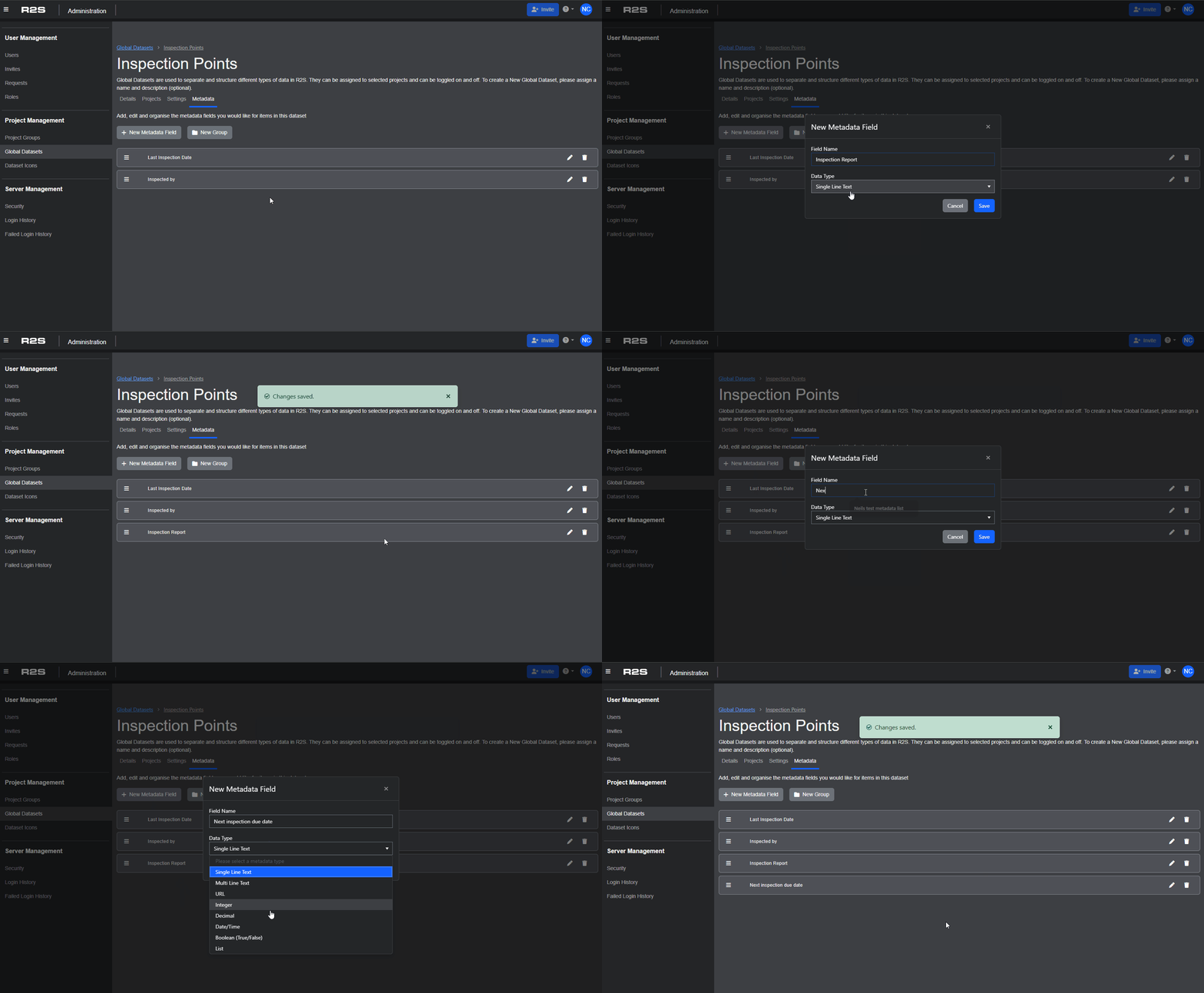
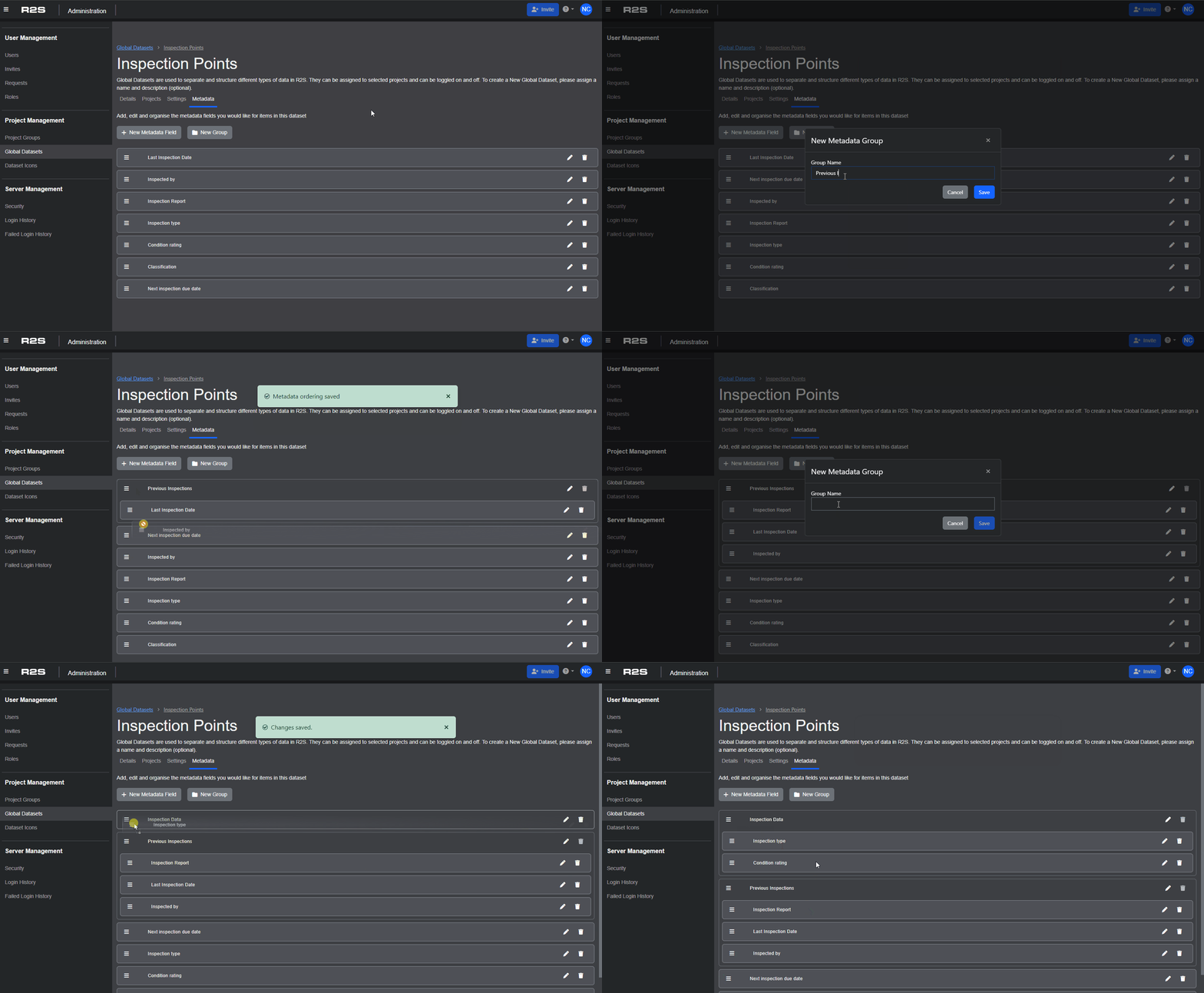
You can reorder existing metadata fields by dragging them to a new position in the list. Fields can also be grouped to enhance structure. The groups and order you define here determine how they appear in the Tag Panel.
Have a look through this interactive guide to learn how to set-up metadata fields for a Dataset designed to support shutdown planning.
Follow these links to discover alternative ways to add Datasets to your project.
To learn how Datasets are used in R2S, see the Tags and Tasks page.
Note: If you are having trouble using any tool or feature in R2S please contact our support team here.